
The TightRope procedure is an extracapsular technique used to stabilise the knee following a cranial cruciate ligament (CCL) rupture. It utilises a strong synthetic implant placed through bone tunnels to provide support to the joint.
While TightRope surgery can be an effective treatment option in some cases, advances in veterinary orthopaedics and our own clinical experience have led us to favour alternative procedures that we believe provide more predictable outcomes for the patients we see.
 At Southern Animal Health, we currently perform the following cruciate repair techniques:
TPLO (Tibial Plateau Levelling Osteotomy)
For many medium to large breed dogs, TPLO is considered the gold standard treatment for cruciate ligament disease.
Why we often recommend TPLO:
- Excellent long-term stability of the knee joint
- Particularly well suited to active, athletic and larger breed dogs
- Does not rely on an artificial ligament remaining intact
- Consistently strong return-to-function outcomes following recovery
- Extensive research supporting long-term success
De Angelis (Lateral Suture) Repair
The De Angelis technique is a well-established extracapsular repair that uses a strong nylon suture placed outside the joint to restore stability while healing occurs.
Why we may recommend De Angelis repair:
- Excellent option for small breed and lighter-weight dogs (especially up to 15 kg’s).
- Less invasive than osteotomy procedures
- Proven track record with decades of successful use
- Cost-effective compared with more advanced orthopaedic procedures
- Can provide excellent outcomes when selected for the appropriate patient
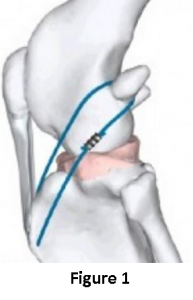
The DeAngelis suture anchors around a small moveable bone called the fabellar which sits behind the distal end of the femur (see figure1).
Every dog is different. Factors such as body weight, activity level, age, breed, tibial plateau angle and owner goals all influence which procedure is most appropriate. Our veterinarians will discuss the available options and recommend the surgical approach most likely to achieve the best outcome for your individual pet.